Markets
China

Market Characterization for Portugal

In 2025, China ranked as the 16th largest source market for Portugal in terms of overnight stays (share: 1.0%) and the 14th largest in terms of visitor numbers (1.7%). In 2025, the Chinese market recorded approximately 339,800 guests (year-over-year change: +18.5%), who generated 593,400 overnight stays (year-over-year change: +15.7%). It stands out as the 22nd largest market in terms of tourism revenue, with €174.5 million (share: 0.6%), up 12.6% compared to 2024.

In terms of overnight stays, Greater Lisbon was the main destination for Chinese tourists visiting Portugal (49.5%), followed by the North (23.5%), the Setúbal Peninsula (8.4%), and the Algarve (7.7%). By type of accommodation, hotel stays predominated (74.8%), followed by private lodging (11.6%) and apartment hotels (8.3%).

The airlines that transported Chinese tourists to Portugal were: Beijing Capital Airlines (share: 64.1%), Emirates Airline (7.7%), TAP (4.3%), Lufthansa (4.1%), and Turkish Airlines (2.4%). Most flights originated in Hangzhou (share: 66.7%), followed by Shanghai (14.7%), Beijing (10.5%), and Guangzhou (4.0%).

According to SIBS data, Greater Lisbon accounts for 72.1% of the €28.8 million in card purchases originating from China in 2025. The North region ranks second (share: 17.1%).

2025 Position | Year-over-Year Change
Guests 0.3M 14º | 18.5%
Overnight stays 0.6M 16º | 15.8%
Tourism revenue 174.5M€ 22º | 12.6%

Market Profile

Change 24/23
1409.0 M Population
-0.1 %
25015.3 USD GDP per Capita
7.2 %
1 % Inflation Rate
0.8 pp
42.8 % Savings Rate
0.0 pp

China is an Asian country with a population of 1,408.3 million in 2024 and was the world’s second-largest economy.

According to Globaldata, in 2024, China was the world’s leading source market for tourists, generating 162.2 million trips and accounting for 10.2% of total global tourism demand. Approximately 83.6% of tourist flows are concentrated in Asia, while Europe accounts for 11.5%. The top five regions sending Chinese tourists to Portugal were Hangzhou (share: 45.4%), Shanghai (22.7%), Beijing (20.4%), Guangzhou (6.6%), and other cities (4.9%).

In turn, 20.1% of trips abroad taken by Chinese tourists in 2024 were by air, 73.1% were by land, and 6.8% were by sea.

Team

Perspectives

The IMF’s projections indicate that China’s economy will grow by 5.2% in 2023, despite the current unfavorable international environment: conflict in Ukraine and the Middle East, and rising costs for energy, raw materials, and intermediate goods. For 2024 and 2025, significant growth is expected to remain solid: 4.8% and 4.5%, respectively.

According to GlobalData estimates, between 2025 and 2028, international departures by Chinese tourists are expected to grow at a CAGR of 2.8%, reaching 183.4 million departures in 2028. Spending by Chinese tourists abroad is expected to increase at a CAGR of 3.3% over the same period.

According to OAG Schedules Analyzer, based on the 2025 summer season compared to 2024 (April 1 to September 30, 2025), China’s air capacity in terms of available seats to major European destinations was led by Italy: 595,000 seats (+12.9%); followed by Turkey: 420,000 seats (-14.4%); Spain: 330,000 (+35.9%); Greece: 60,000 (-4.6%); and Portugal: 20,000 (-50.1%).

Forwardkeys data on bookings indicate that passenger forecasts from the Chinese market to Portugal for the period from June to November 2025 are expected to increase (+12.5%) compared to the same period the previous year.
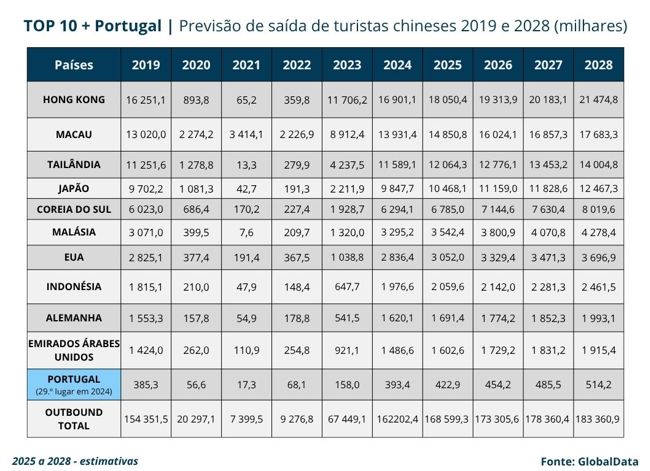
tabela-china-travelbi.jpg